
Human-in-the-Loop E-Commerce AI Assistant
A production-shaped agentic commerce system for a vinyl store catalogue: an LLM shopping assistant that browses, recommends, and builds carts through a scoped MCP tool surface, while the only code path that creates a billable order is a human approval action in a sales console. The agent reasons over four distinct retrieval strategies , structured SQL, Elasticsearch full-text, local-embedding vector search, and multi-hop Neo4j graph traversal , plus a hybrid recommender that stays useful for brand-new customers.
- 8
- Agent tools exposed over MCP
- 4
- Retrieval strategies
- 66
- Automated tests passing
- 100%
- Cold-start recommendation coverage
The challenge
The goal was a conversational front door for a catalogue of 275 artists, 347 albums and 3,503 tracks that can genuinely sell , recommend, build a cart, take a purchase request , while being structurally unable to spend the business's money on its own. Prompt instructions are a hope, not a control, so the objective was to design the tool surface itself so unauthorized orders and model-invented prices are impossible rather than unlikely.
Approach
- Gave the agent a single, deliberately narrow channel to the data: an MCP tool server running as an isolated subprocess with 8 tools, on a read-only database connection so even a bypassed application check cannot write. No tool in the toolbox can create an order , the agent can only file a purchase request into a review queue.
- Built the human-in-the-loop sales console as the one code path that turns a request into a billable order, gated by an atomic status transition so two employees acting on the same request cannot double-create it; every decision and the employee behind it is recorded by construction. Every amount shown or billed is recomputed server-side from live catalogue prices.
- Structured query tool: direct SQLAlchemy/SQL access for exact lookups , tracklists, precise matches, aggregates , returning in ~1ms so the conversation feels instant.
- Full-text relevance tool: Elasticsearch ranked, typo-tolerant search, so "Metalica" still resolves to Metallica when a customer's phrasing doesn't match the catalogue.
- Semantic vector tool: a local embedding model (no external API dependency) matches mood and vibe descriptions , "something moody and atmospheric" , against artist style descriptions by meaning rather than keywords.
- Knowledge-graph tool: a Neo4j graph of artists, genres and real cross-customer co-purchase patterns, queried with genuine multi-hop Cypher traversal to answer "similar to X" , which works with zero purchase history and so solves the cold-start case that history-only recommendation cannot.
- Layered a hybrid recommender over the tools, blending a customer's own history with patterns from customers who share their taste, cached per customer and invalidated the moment a new purchase changes what should be recommended.
- Made every optional service degrade gracefully to a working fallback, bound the acting customer identity server-side from the authenticated session so the agent's own output can never widen its access, and provisioned the search and graph infrastructure as Terraform-reviewed, cost-estimated AWS resources.
Outcome
The agent picks the right retrieval strategy per turn , exact catalogue lookups in ~1ms, graph-based similarity in ~1s , and returns grounded recommendations even for first-time customers, where purchase-history recommendation covers nothing by definition. 66 automated tests cover pricing correctness, concurrent-approval races, duplicate purchases and malformed input against an isolated database copy. The result is an agentic commerce reference build where unauthorized order creation isn't a low-probability risk but an absent capability, and the audit trail is a structural property of the approval workflow rather than a later addition.
Results in detail
Figures are from the delivered engagement, normalised where data is confidential.
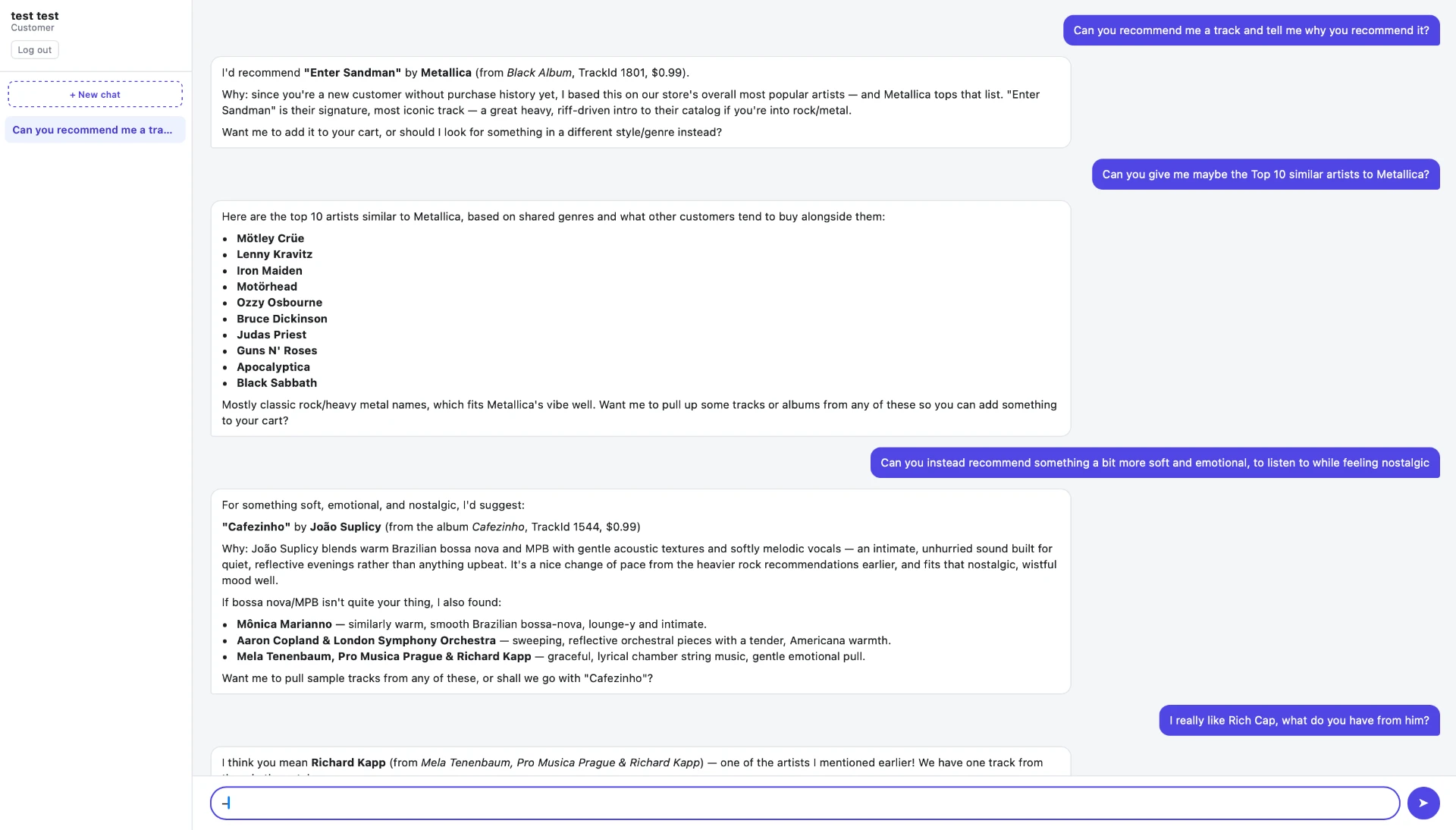
Customer conversation with the shopping agent
Real session: a popularity-grounded recommendation for a new customer, a graph-traversal "similar to Metallica" list, a mood-based semantic pivot to Brazilian MPB, then typo-tolerant recovery of a misremembered artist name , four retrieval strategies inside one conversation.
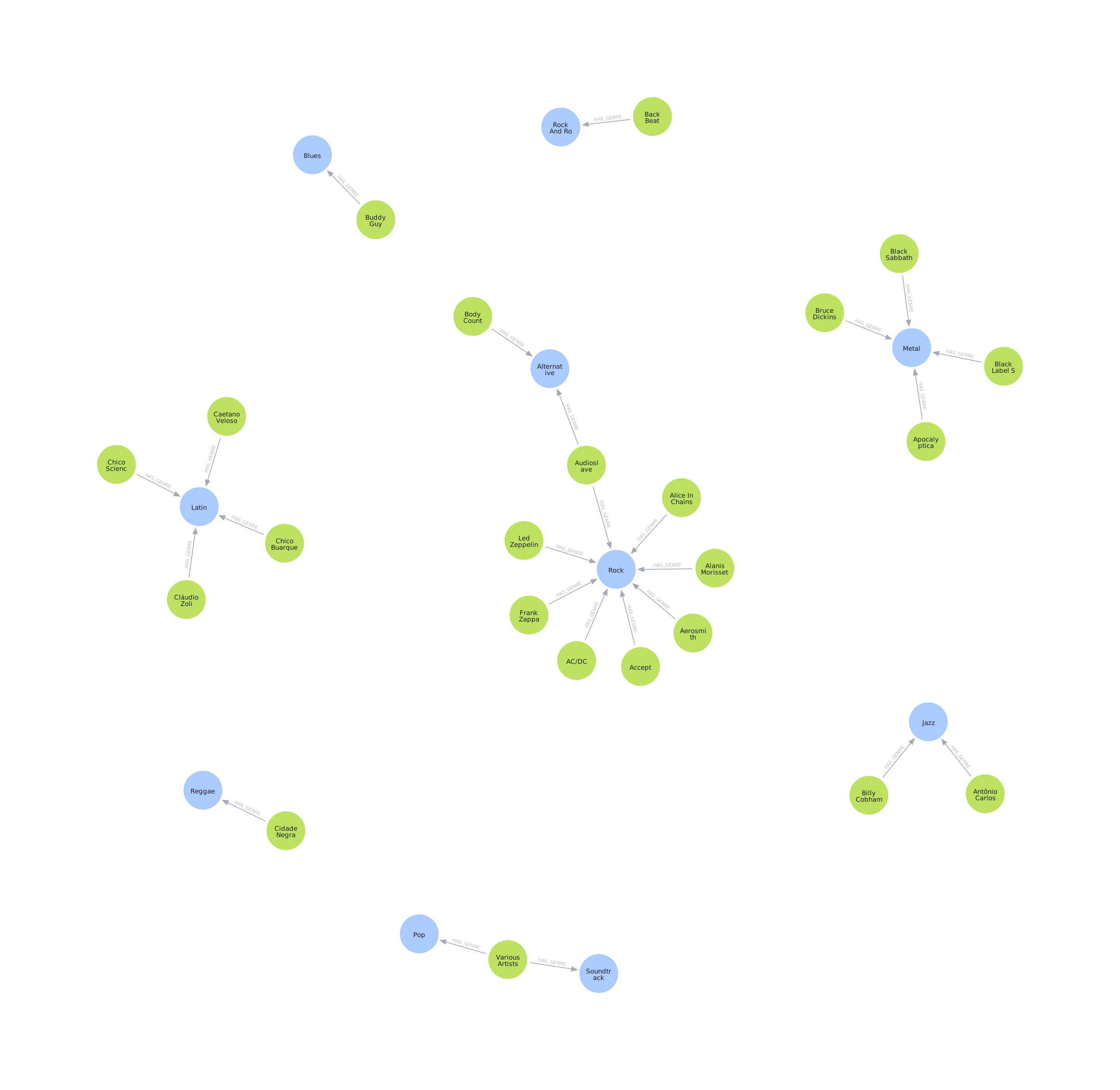
Genre–artist knowledge graph behind recommendations
Neo4j graph of artists linked by shared genres and real cross-customer co-purchase edges. Multi-hop traversal over these relationships is what produces "similar to X" answers for customers with no order history.
Typical response time by retrieval strategy
Measured against this build; log-friendly comparison in milliseconds.
Recommendation coverage by customer type
Purchase-history-only recommendation covers no first-time customer by definition; the graph fallback extends grounded recommendations to all of them.
Related projects
Privacy-preserving ML / Edge
Federated Privacy-Preserving Typing Assistant
Next-word prediction trained across distributed clients where only differentially-private model updates ever leave the device.
AI platform / Infrastructure
LLM Fine-Tuning, Compiling and Serving Optimization Benchmarks
Qwen2.5-3B-Instruct benchmarked end to end , distributed DPO training, hand-written CUDA kernels, a three-way inference-engine comparison, Triton serving and Kubernetes autoscaling.
Automotive / Supply chain quality
Semantic Anomaly Detection & Classification for Supply Chain Operations
A hybrid deep-learning and classic-ML anomaly detection platform that flags supply-chain irregularities and recommends classification.
Fashion retail / Influencer marketing
Outfit Recommender and Influencer Portfolio Optimizer
Built on a company's own catalogue: compose outfits from its products, then pick the influencer marketing portfolio that best fits them under a budget.